
The Benefits of the Turkish Get-Up
The get-up is slow, quiet and unglamorous, and it teaches more about how your body works than anything else we coach. Here is what it builds, how the positions fit together, and how we teach it at Liberty Bells in Leander, TX.
What the Get-Up Gives You
Shoulder Stability
The bell stays locked overhead through every position. Your shoulder learns to stay packed and controlled while the rest of the body moves underneath it — the single best insurance policy for pressing.
Core Strength in Every Direction
Rolling, bracing and resisting rotation under load trains the midsection the way it actually works: to keep you stable, not to crunch.
Full-Body Control
Floor to standing and back again, one position at a time. You find out exactly where your control runs out, then you fix it.
Mobility You Can Use
Thoracic rotation, hip extension in the lunge, ankle and wrist position — all loaded, so the range you gain is range you own.
Left-Right Honesty
One side at a time exposes imbalances a barbell hides. Most people find one side noticeably smoother, and the get-up is how they close the gap.
Getting Off the Floor
The most practical skill on this list. Standing up from the ground with a load overhead is the pattern that keeps people independent for decades.
The Positions, In Order
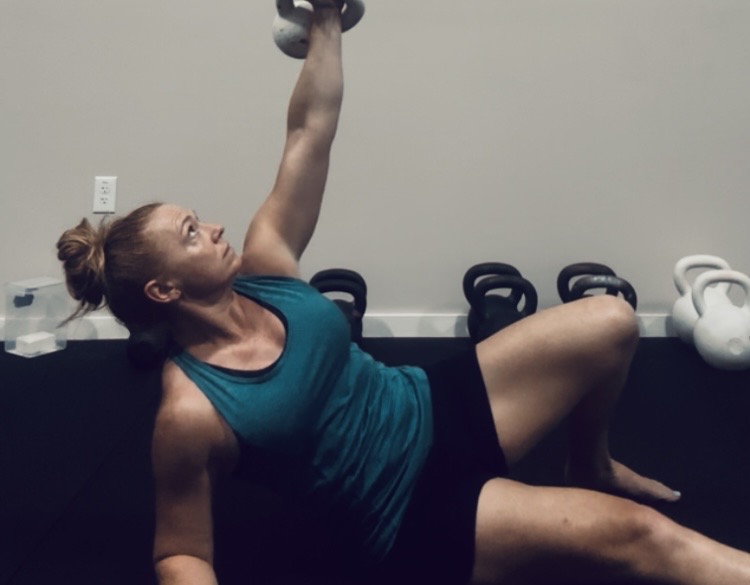
- 1. Roll to press. Lie on your side, two hands on the handle, roll to your back and press the bell up. Never press it from flat on your back with one arm.
- 2. Roll to elbow. Same-side knee bent, free arm at 45 degrees. Punch the bell up and drive onto your bottom elbow, chest open.
- 3. To the hand. Straighten the bottom arm. Shoulders stay stacked, eyes on the bell until standing.
- 4. High bridge and sweep. Lift the hips, sweep the straight leg back underneath you into a half-kneeling position.
- 5. Windshield wiper to lunge. Turn the back shin to face forward, torso vertical, bell locked overhead.
- 6. Stand, then reverse it. Drive up to standing. Then take the same road home, one position at a time. The way down is where the strength is built.
The get-up is practice, not a workout finisher. Every position should be one you could hold and breathe in. If a position feels rushed, that is the one to work on.
Get-Up Questions
What are the benefits of the Turkish get-up?
Shoulder stability, core strength in every direction, loaded mobility through the hips and upper back, and full-body control. It also exposes left-right differences that other lifts hide.
What muscles does the Turkish get-up work?
Nearly all of them. Shoulders and upper back hold the bell, the core and obliques resist rotation, and the glutes, quads and hamstrings do the work of standing up.
What weight should I use for a Turkish get-up?
Start far lighter than you expect — many people learn with a shoe on the fist, then an 8 or 12 kg bell. Load goes up only when every position is smooth and controlled.
How many Turkish get-ups should I do?
Low reps, high quality. One to five reps per side, treated as practice rather than a set to grind out, is plenty in a session.
Is the Turkish get-up good for shoulder health?
For most people, yes — it trains the shoulder to stay stable under load through a full range. If you have a current shoulder injury, get cleared by your doctor and tell your coach first.
Can beginners do the Turkish get-up?
Yes, broken into pieces. We teach the roll-to-elbow and the bridge separately before anyone strings the whole thing together, and it is part of our beginner progression.
Learn the Get-Up With a Coach
The get-up is worth learning in person, one position at a time. Come in for a free class at 401 S. Chitalpa St., Unit 720, Leander, TX.